.svg)



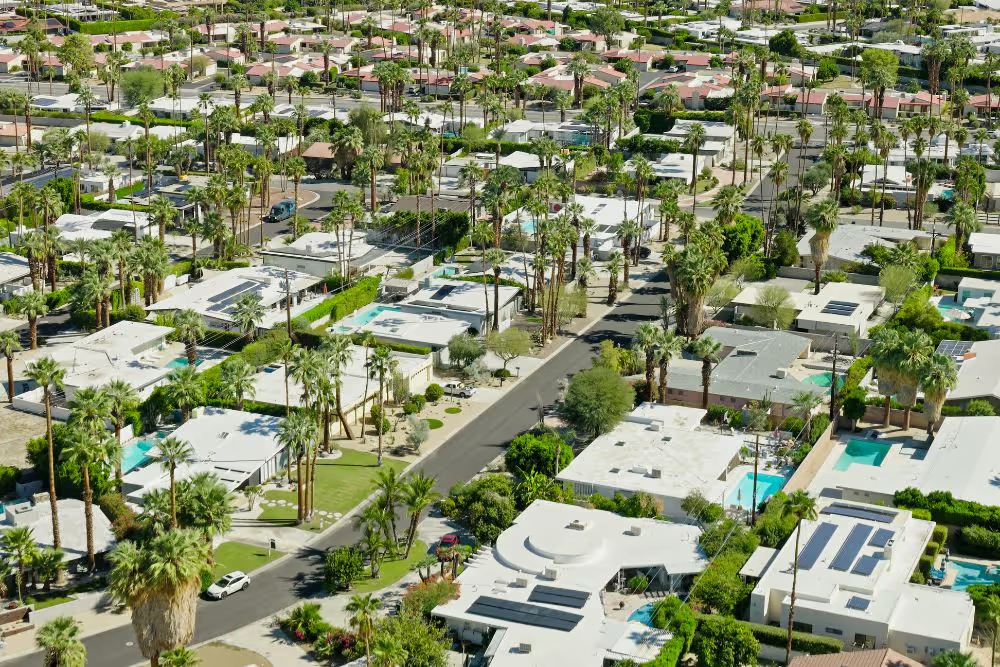
Palm Desert house painters handle more than color. This covers interior and exterior painting costs, surface repair, the full process from prep to final coat, and what to look for before hiring in the Coachella Valley.
Interior and Exterior Painting Costs in Palm Desert
Palm Desert house painters charge $2 to $5 per square foot for interior work. Exterior painting on a typical Coachella Valley home runs $4,500 to $12,000 depending on surface condition, repair scope, prep requirements, and the coating system used. Homes with full elastomeric systems, significant stucco repair, or multiple stories will push toward the higher end or past it.
The repair component is what changes the math most in Palm Desert. A lot of homes here have been sitting in the sun for 10 to 20 years without a full repaint. By that point, the chalking is heavy, the caulk at window frames has separated, and there are stucco cracks that need elastomeric patching before any primer goes on. Repair is built into the scope on most exterior jobs in this market, not an afterthought.
Interior work varies too. A fresh coat in a recently built home with drywall in good shape is a different job than a repaint in an older property with water-stained ceilings, failed texture in one bathroom, and cabinets that haven't been touched since they were installed. The prep and repair on the second project costs more and takes longer.
Cost Ranges at a Glance
Final cost depends on square footage, number of stories, surface condition, repair scope, primer type, number of coats, and coating system. Use our Coachella Valley painting cost calculator for a project-specific estimate.
Surface Repair Before Painting in Palm Desert
Most exterior painting jobs in Palm Desert involve surface repair. This is not optional prep you can skip to save money. It is the reason a paint job lasts or doesn't.
Stucco cracks are the most common repair we handle. The desert thermal cycle, hot days and cooler nights, causes stucco to expand and contract repeatedly. Over years that movement creates hairline cracks at window corners, along wall bases, and at transition points between dissimilar materials. Those cracks need to be filled with a flexible elastomeric caulk or stucco patch product before primer goes on. Rigid patching compounds like standard joint compound won't hold up. The stucco will keep moving and the patch will crack again in a season or two.
Larger structural cracks or areas where the stucco has separated from the substrate are a different repair category. Those need to be cut out, the underlying lath or substrate assessed, and the area re-stuccoed before painting begins. We refer significant structural stucco failures to a plastering specialist when the damage is beyond cosmetic repair, but most hairline and surface cracking we handle as part of the painting scope.
Wood rot repair is the other major pre-paint repair we encounter in Palm Desert. Fascia boards, window frames, and door casings are the most common locations. We treat soft wood with epoxy consolidant to stabilize the fibers, fill voids and missing sections with two-part epoxy wood filler, sand smooth, and prime with an oil-based alkyd primer before the finish coat goes on. Skipping this step and painting over soft wood gives you a nice-looking surface for about one season before the rot resumes underneath and the paint starts to bubble and lift.
On a recent job at a home in Sun City, Palm Desert, the homeowner had been told by two other painters that the house just needed a coat of paint. When we got up close on the inspection, the west-facing fascia boards had significant rot from years of irrigation spray, three window frames had soft sections, and the stucco at the base of the garage had a separation crack running about eight feet. All of that had to be addressed before primer went on. The repair scope added time and cost, but it's the only way the paint job actually holds up.
Desert Climate and Exterior Painting in Palm Desert
Palm Desert sits at the eastern end of the Coachella Valley and gets some of the most intense UV exposure in California. Surface temperatures on west-facing stucco walls regularly hit 160 to 170 degrees in summer. The combination of extreme UV, sustained heat, and nightly temperature drops puts more stress on exterior coatings than most other climates in the state.
Standard 100% acrylic exterior paint handles those conditions, but its service life is shorter than in cooler regions. A product rated at 15 years in a moderate climate will typically give you 7 to 10 years in the desert under good conditions: proper prep, proper primer, and two coats. Anything less and you'll see chalking, fading, and hairline cracking before the five-year mark.
Elastomeric coatings are the premium option for Palm Desert stucco homes. Products like Sherwin-Williams Loxon XP and Dryvit or Sto elastomeric systems are engineered to flex with the substrate as it moves with temperature swings. They build a film of 10 to 40 dry mils, compared to 1.5 to 2 mils for standard latex. That film thickness is what delivers crack-bridging performance. A properly applied elastomeric system over an elastomeric masonry primer can hold up 15 to 20 years on desert stucco.
We schedule exterior painting carefully in summer. Application starts at 6 AM and we're done with outdoor work by 10 or 11 before surface temperatures spike. Paint applied to a surface above 100 degrees skins over before it penetrates the substrate, which causes immediate adhesion problems. We check surface temperature with an infrared thermometer before starting each morning. September through May is the ideal window for exterior work in Palm Desert. Summer jobs get done but require disciplined scheduling.
The Full Exterior Painting Process
Back-rolling after spraying is not optional on stucco. Spraying alone leaves paint bridging over texture peaks without penetrating the valleys. Back-rolling pushes the wet product into the texture, eliminates runs, and ensures full adhesion. Skipping it is a common shortcut that leads to early delamination on desert stucco homes.
Interior House Painting in Palm Desert
Interior painting in Palm Desert follows the same discipline as exterior work: preparation determines the result. The focus shifts from UV and thermal cycling to surface repair quality, adhesion on previously painted surfaces, sheen selection, and consistency under the lighting conditions specific to each room.
Most valley homes have drywall walls and ceilings. New drywall needs a PVA drywall sealer before finish coats. Without it, the porous gypsum pulls paint unevenly and produces flashing: a flat, patchy look that additional coats won't fix. Existing walls in good condition can typically go straight to finish coats after cleaning and a light sand on rough spots. Glossy surfaces need to be deglossed by sanding or with a liquid deglosser so the new paint bonds properly.
Interior repairs commonly include patching drywall holes and dings with lightweight joint compound or pre-mixed patch products, spot-priming repaired areas with a bonding primer, sealing water stains on ceilings with a shellac-based stain blocker like Zinsser BIN before the finish coat, and treating mold or mildew spots with appropriate antimicrobial treatment before repainting bathroom walls.
Sheen selection matters for both durability and how a room reads. Flat paint hides imperfections but isn't washable. Eggshell is the standard for most living areas: slight sheen, cleanable, forgiving on walls that aren't perfectly smooth. Satin is recommended for kitchens, bathrooms, laundry rooms, and high-traffic hallways. Semi-gloss or gloss for trim, doors, and cabinets: those surfaces take the most impact and need a harder film.
Cabinet refinishing is a separate discipline. We spray cabinets with an HVLP system like a Fuji Q4 Pro for fine atomization and a smooth, factory-quality finish. The substrate gets cleaned, deglossed, and primed with a shellac or oil-based cabinet primer like Zinsser Cover Stain before the topcoat. The topcoat is a cabinet-specific enamel: Benjamin Moore Advance or Sherwin-Williams ProClassic. Two coats minimum with a light scuff sand between coats. The finish holds up to daily use far better than a brushed finish can.
HOA Painting in Palm Desert: Color Approval and Compliance
A large share of Palm Desert's residential neighborhoods are governed by homeowners associations. Sun City Palm Desert, Bighorn Golf Club, The Gallery, Silver Spur Ranch, and dozens of other communities have architectural review committees that must approve exterior paint color changes before work begins. Painting without approval in an HOA community is one of the faster ways to get a violation notice and a forced repaint at your own cost.
Most HOAs in Palm Desert require you to submit an Architectural Review Committee (ARC) application that includes the brand, color name, color code, and finish type of the products you're planning to use. Some communities have pre-approved palettes and the process is straightforward. Others review color submittals on a case-by-case basis and can take two to four weeks to respond. If you're repainting in the same color, some associations don't require prior approval at all, but it's worth confirming in writing before work begins.
We handle HOA documentation and color submission as part of our project coordination. We know which products Sherwin-Williams and Benjamin Moore designate as HOA-compatible and can pull the spec sheets and color chips an architectural committee needs. If your color submission gets pushed back or rejected, we help work through alternatives that stay within the approved palette while still getting you a result you're happy with. Color approval takes time, so we recommend starting that process before scheduling paint work so there's no delay when the crew is ready to go.
One thing worth knowing: HOAs in Palm Desert tend to favor neutral and earth-tone palettes that hold up visually in a desert environment and don't create color contrast issues with neighboring properties. Warm beiges, sand tones, greige neutrals, and muted terracotta are consistently approved. Bright accent colors or high-contrast schemes usually don't make it through the ARC process without modification.
Paint Brands and Products for the Desert
We work with Sherwin-Williams and Benjamin Moore on most projects. Both produce professional-grade products that hold up in extreme UV and sustained heat. The difference between a premium exterior paint and a mid-grade product is typically $20 to $40 per gallon. On a standard exterior job that's roughly $300 to $600 more in materials. Spread over a service life of 7 to 15 years, the math favors going with the better product.
Tools and Equipment on a Palm Desert Painting Job
What a crew shows up with matters. A sprayer and a few rollers is the bare minimum. A professional job in Palm Desert requires considerably more, especially on homes with significant repair scope, stucco texture variation, or ironwork that needs specialized prep.
- Airless sprayer: Graco or Titan units at 2,000 to 3,300 PSI for exterior stucco and broad interior surfaces; tip selection matched to product viscosity, larger orifice tips for heavy elastomeric coatings
- HVLP sprayer: Fuji Q4 Pro or similar turbine unit for cabinet refinishing and fine interior trim; fine atomization, minimal overspray, factory-quality finish
- Rollers: Purdy or Wooster frames with nap thickness matched to surface texture; 3/8" for smooth interior drywall, 3/4" or 1" for heavy stucco texture, 18" frames for large field coverage
- Brushes: Purdy Clearcut or Wooster Alpha angled sash brushes for cutting in at trim lines; nylon and polyester bristles for latex and water-based products
- Random orbital sander: Festool ETS EC or Makita with HEPA dust extraction for sanding drywall patches, feathering paint edges, and deglossing interior surfaces
- Pressure washer: Gas-powered Simpson or Generac unit at 2,500 to 4,000 PSI for exterior cleaning and chalk removal; electric units for lighter prep work on single-story sections
- Oscillating multi-tool: Fein or Milwaukee for removing failed caulk at window frames and trim transitions without damaging the surrounding substrate
- Masking machine: 3M Hand-Masker for fast tape-and-paper or tape-and-plastic masking at trim lines, ceiling breaks, and adjacent surfaces
- Infrared thermometer: Surface temperature check before paint or coating application; non-negotiable in Palm Desert's summer heat before elastomeric work
- Wet film thickness gauge: Verifies application rate on elastomeric coatings to confirm rated dry film thickness is achieved across the entire surface
Surfaces Palm Desert House Painters Work On
A full residential paint scope in Palm Desert covers a wide range of surfaces. Each one has specific prep, primer, and product requirements. Treating them all the same way is how paint jobs fail early.
When Roofing and Exterior Painting Overlap
On exterior painting jobs in Palm Desert, we often find problems at the roofline that have nothing to do with the paint itself. A failing flashing joint above a window that's been leaking for a season. Fascia board rot driven by a gutter that's been pulling away from the eave. Stucco damage at a parapet wall where the cap flashing has lifted. These are roofing issues, but they show up as paint problems because that's where the water damage becomes visible.
When we find this on an inspection, we stop and flag it. Fresh paint over an unresolved roof leak won't last a year. The moisture will push through and the new coating will blister and peel from the back side. The right sequence is to resolve the roofline issue first, let things dry out, and then paint. Our roofing team in Palm Desert handles repairs and inspections as a separate scope. When both trades are needed, we coordinate the schedule so the painting crew doesn't start until the roofline work is complete and dry.
Licensing and What to Ask Before Hiring a Palm Desert Painter
California painting contractors are required to hold a C-33 Painting and Decorating license issued by the Contractors State License Board. That classification covers surface preparation, priming, and application of paints, stains, varnishes, shellacs, and specialty coatings. You can verify any contractor's active license status on the CSLB license check tool at no cost before signing anything.
If your home was built before 1978, lead-based paint may be present in existing coatings. The EPA's Lead Renovation, Repair and Painting (RRP) Rule requires that contractors disturbing more than six square feet of painted surface in pre-1978 homes be EPA-certified and follow lead-safe work practices. That includes HEPA vacuum dust collection during sanding, work area containment, and proper cleanup. Ask any contractor working on a Palm Desert home built before 1978 whether they hold EPA RRP certification.
Painting in Palm Desert generally does not require a building permit. Structural repairs to stucco, fascia, or other elements of the building envelope may trigger a permit requirement depending on scope. If there's any question about your specific project, the Palm Desert Building and Safety Department can confirm what's required before work begins.
Truly Tough Painting: Interior, Exterior, and Repair in Palm Desert
Our painting team at Truly Tough Painting handles interior repaints, exterior stucco systems, elastomeric coatings, stucco and wood repair, cabinet refinishing, and HOA color documentation across Palm Desert, Palm Springs, La Quinta, Indio, and the rest of the Coachella Valley. We use Sherwin-Williams and Benjamin Moore products on every job, back-roll every sprayed exterior surface, and prime every surface that needs it. A written scope of work, product documentation, and a final walkthrough come standard.
Call us at 760-343-5770 or reach us at Painting@TrulyTough.com.
Frequently Asked Questions
How much does interior painting cost in Palm Desert?
Interior painting runs $2 to $5 per square foot depending on surface condition, sheen selection, repair scope, and number of coats. A single room averages $900 to $2,300. A full interior repaint on a mid-size home can run $5,000 to $12,000 or more.
How much does exterior house painting cost in Palm Desert?
Most exterior repaints on a standard Coachella Valley home run $4,500 to $12,000. Homes with significant stucco repair, wood rot, multiple stories, or a full elastomeric coating system will run higher depending on scope.
Do painters in Palm Desert handle stucco repair?
Yes. Surface repair is built into most exterior paint scopes in this market. Hairline cracks, failed caulk at window frames, and minor stucco damage are addressed before priming. Major structural stucco failures that require re-stuccoing a section are typically handled as a separate trade scope.
How long does exterior paint last in Palm Desert?
A standard 100% acrylic exterior paint with proper prep and two coats lasts 7 to 10 years in the desert. A full elastomeric coating system on stucco can last 15 to 20 years. UV intensity and thermal cycling are the primary factors that shorten paint life in this climate.
Do I need HOA approval to repaint my home in Palm Desert?
If you live in an HOA community and are changing your exterior color, yes. Most Palm Desert HOAs require an ARC application with color name, code, brand, and finish type before work begins. Repainting in the same color often does not require prior approval, but confirm with your HOA in writing before scheduling.
What is an elastomeric coating and do I need it in Palm Desert?
Elastomeric coatings are thick, flexible paint systems that bridge hairline cracks and flex with stucco as it expands and contracts in the heat. They're the recommended exterior coating for stucco homes in the desert. The service life is significantly longer than standard acrylic paint.
What is a C-33 license and why does it matter?
A C-33 is the California painting and decorating contractor license issued by the CSLB. It means the contractor passed a trade exam covering surface prep, primer use, and coating application. Verify any painter's C-33 is active on the CSLB website before signing a contract.
Does my pre-1978 Palm Desert home have lead paint concerns?
It may. Homes built before 1978 can have lead-based paint in existing coatings. Contractors disturbing painted surfaces in pre-1978 homes must be EPA RRP certified and follow lead-safe work practices including HEPA dust collection and proper containment.
Is one coat of exterior paint enough?
No. Two coats are the minimum for proper film thickness, full hide, and color accuracy. One coat in a desert climate won't provide adequate UV protection or durability, and you'll see wear and fading well ahead of what a properly applied two-coat system would deliver.
What paint brands do professional painters in Palm Desert use?
Most professional painters in the Coachella Valley work with Sherwin-Williams and Benjamin Moore. For exterior stucco, Sherwin-Williams Duration and Loxon XP are common choices. For interior, Emerald and Aura are the standard premium lines.






.svg)
