.svg)


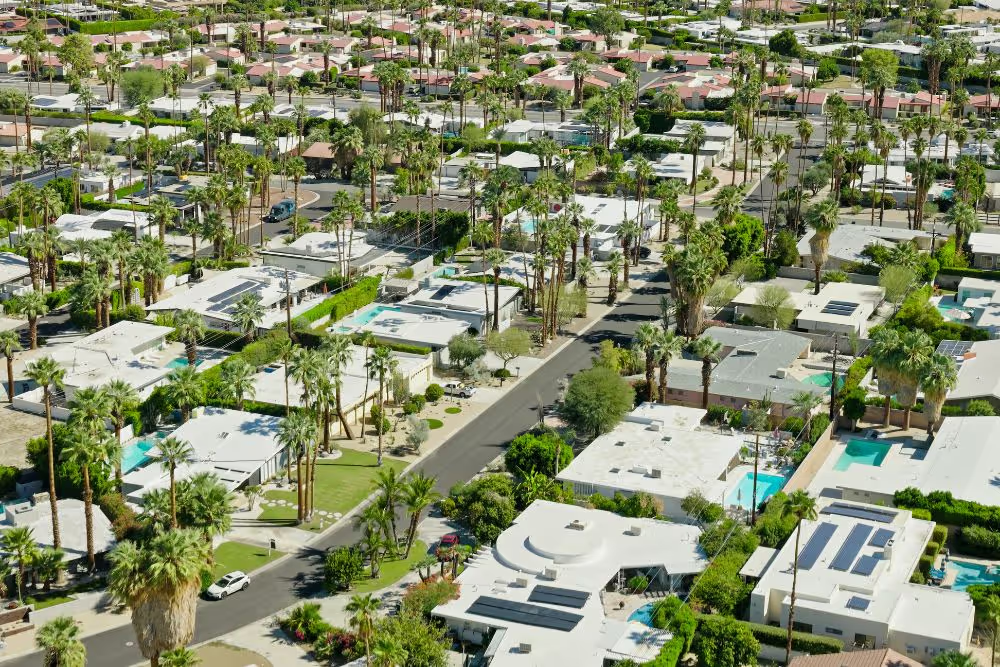
Palm Springs solar customers are choosing between local installers and national brands every day. The company you pick affects more than the price tag on your quote.
Local vs National Solar Installer in Palm Springs
Choosing a local Palm Springs solar installer over a national company is the right call for most Coachella Valley homeowners, and the reasons go well beyond price. Local installers know the city permit process, have existing relationships with SCE, understand how desert roofs perform under real conditions, and will pick up the phone when something needs attention two years after your system goes live. National companies offer name recognition. In practice, that rarely translates into better service on the ground.
That is not a blanket dismissal of every national brand. Some large companies do solid work in specific markets. But the model that most of the big national solar outfits operate on relies heavily on subcontractors, high-volume sales teams, and standardized system designs that are not built around your specific roof, your specific utility rates, or your specific usage patterns. When you sign with a national company, you often do not know who is actually showing up to install until a few days before.
This article walks through the real differences so you can evaluate any company you are considering, local or national, and ask the right questions before signing anything.
Where Local Installers Have a Clear Edge
The advantages of a local Palm Springs solar company are most visible in the parts of the process that rarely show up in a sales presentation.
The Subcontractor Problem
The single biggest structural issue with many national solar companies is how they staff their installations. Most large national brands do not employ their own installation crews in every market they serve. They use subcontractors. The sales rep and the design team are employees of the national company. The people who actually show up on your roof may work for a separate local roofing or electrical contractor that the national company has a regional agreement with.
This matters for a few reasons. Subcontracted crews have split accountability. Their relationship is with the subcontracting agreement, not with your satisfaction as a customer. Quality control is harder to enforce across a network of third-party crews than it is with employees who work for the same owner every day. And when something goes wrong, figuring out who is responsible gets complicated fast. Is it the national company? The subcontractor? The equipment manufacturer? Each party points to the others.
A local installer with its own installation team has one clear accountability structure. The people installing your system work for the same company that sold you the system and will be servicing it in five years. That alignment of incentives produces better work. It also means the installer has a real reason to get the design right the first time, because they are the ones who will be called back if something is off.
What National Companies Do Well
Being fair about this matters. National solar brands have real advantages in certain areas, and a homeowner making this decision should understand what they are actually trading off.
Large national companies have significant purchasing power. They buy panels, inverters, and racking in volume and can access pricing that smaller local companies cannot match on equipment cost. In some cases that translates to better panel options. In others, the savings go to company margins rather than the customer's quote. It depends on the company and the market.
National brands also carry name recognition that some homeowners find reassuring, particularly around warranty claims. If you buy a system from a company with 500,000 customers, the logic goes, they will still be around in 15 years to honor the workmanship warranty. That is worth considering. Local companies do go out of business. The solar industry has had its share of companies that left homeowners with no service path for systems still under workmanship warranty.
The honest counter to that point is that many national solar companies have also gone under or dramatically scaled back, leaving customers with the same problem. Sunpower, once one of the largest residential solar brands in the country, halted new installations in 2024. Customers who bought from them based partly on brand stability had no more protection than someone who used a small local shop.
Desert-Specific Factors National Companies Often Miss
A solar system designed for a home in Sacramento is not the same as one designed for a home in Palm Springs. The production profiles are different, the shading patterns are different, the roofing considerations are different, and the utility billing structure under SCE's Solar Billing Plan affects how a system should be sized. National companies often apply a templated approach to system design that works adequately in generic markets but leaves production and savings on the table in a desert climate.
We installed a system in Silver Spur Ranch, Palm Desert last year for a homeowner who had received a quote from a national company six months earlier. The national quote was for a system sized to offset 100 percent of their current usage. When we looked at the roof, the proposed panel layout had three panels in partial shade from an HVAC unit for most of the morning during peak summer months. The national company's designer had not caught it. Our shade analysis caught it immediately and we repositioned the array. A system that looked good on paper would have underperformed every single day for 25 years.
Local knowledge shows up in small details like that. The angle of a chimney shadow in December. The way wind loads work on a south-facing low-slope roof in the pass area. Which mounting hardware holds up to summer temperature cycling and which develops micro-fatigue cracks over time. These are things you learn from working in one market for years, not from a regional sales territory that covers three states.
What to Ask Before Signing with Any Solar Company
Whether you are considering a local installer or a national brand, these questions will tell you a lot about what you are actually buying.
- Who installs my system? Find out whether the installation crew are company employees or subcontractors. If subcontracted, ask how the company manages quality control on those crews.
- Have you pulled permits in Palm Springs before? A company that regularly works in the city will have a track record you can verify and will not be learning the permit process on your timeline.
- Will you run a shade analysis specific to my address? Any legitimate design process uses solar pathfinder data or satellite-based shading software to model production at your actual location across all seasons.
- Who handles service calls after installation? Get a clear answer about who you call, what the response time commitment is, and whether service is handled in-house or outsourced.
- Can I verify your license before signing? The California Contractors State License Board website lets anyone look up a license number in seconds. Any company that hesitates on this question is a company to walk away from.
- What does the workmanship warranty actually cover? Get the warranty terms in writing and read them. Some workmanship warranties are conditional on maintenance agreements or exclude specific failure modes that are common in desert climates.
- What is the realistic payback period given my SCE rate plan? A company that cannot give you a specific, documented answer to this question tied to your actual billing history is not doing real system design.
Permits, Licensing, and Protecting Yourself in California
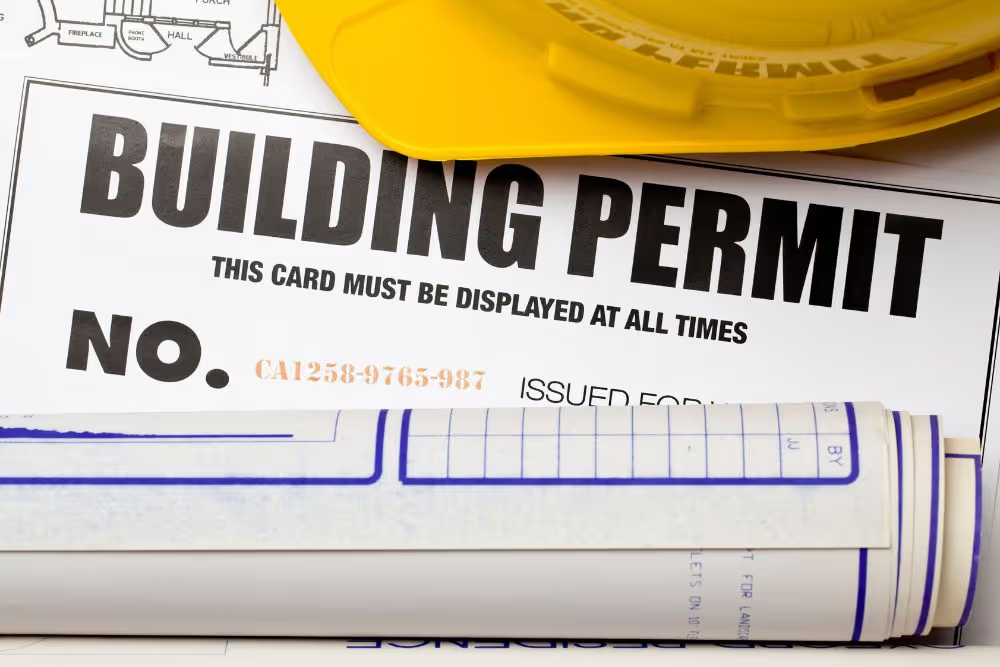
Every solar installation in Palm Springs requires a permit from the City of Palm Springs Building Department. Your installer is responsible for pulling that permit, submitting the design documentation, and coordinating the inspection. A system that was not properly permitted creates problems when you sell the home, file a homeowner's insurance claim, or need warranty service that requires utility involvement.
California law requires anyone installing a solar energy system to hold an active contractor's license. The CSLB's Solar Smart consumer guide lays out exactly which license classifications cover solar work, what must appear in every solar contract by law, and what your rights are if something goes wrong. It also explains the disclosure document that must be included in the front page of any residential solar contract in California. If a company presents you with a contract that does not include this disclosure, that is a violation, not an oversight.
You can verify any contractor's C-46 Solar Contractor license status, bond, and complaint history on the CSLB website at no cost. National companies are not exempt from this requirement. California does not recognize out-of-state contractor licenses. Any company operating here must hold a valid California license regardless of where they are headquartered.
Once installation is complete, the system cannot legally operate until SCE issues Permission to Operate following its own review. The SCE residential solar basics page outlines the full interconnection process. A good local installer manages every step of this and keeps you informed. A national company that subcontracts installation may also outsource the permitting and interconnection paperwork, which introduces more handoffs and more opportunities for delay.
Truly Tough Solar Serving Palm Springs and the Coachella Valley
Our solar division at Truly Tough Solar is a local Coachella Valley team. We handle system design, permitting, installation, and SCE interconnection ourselves across Palm Springs, Palm Desert, La Quinta, Indio, and the rest of the valley. No subcontractors on your roof. No call center when you need service. Every quote starts with a shade analysis specific to your address and a system design built around your actual SCE billing history.
Call us at 760-343-5837 or reach us at Solar@TrulyTough.com.
Frequently Asked Questions
Is a local Palm Springs solar installer better than a national company?
For most homeowners, yes. Local installers bring direct knowledge of Palm Springs permit requirements, SCE interconnection procedures, and desert roofing conditions. They also tend to use their own crews rather than subcontractors, which means tighter accountability and easier service access after the system is live.
Why do national solar companies use subcontractors?
National companies operate across many markets and cannot employ full installation crews in every city they serve. Subcontracting lets them scale volume, but it splits accountability between the company you signed with and the crew actually doing the work. When problems arise, it is harder to get a clear answer about who is responsible.
Are national solar brands cheaper than local installers?
Usually not. Research from the National Renewable Energy Laboratory found that local installers tend to price residential systems roughly 10 percent lower than national companies. National brands carry higher overhead from marketing, sales commissions, and corporate structure that gets built into the quote.
What happens if a solar company goes out of business?
Equipment warranties are held by the manufacturer, not the installer, so panel and inverter warranties survive if the installer closes. Workmanship warranties do not. This risk exists for both local and national companies. Checking a company's history, financial standing, and CSLB complaint record before signing helps you assess long-term reliability.
Do I need a permit for solar in Palm Springs?
Yes. Every solar installation in Palm Springs requires a building permit and SCE Permission to Operate before the system can legally run. Your installer handles both. A company that suggests skipping the permit process to save time is not one you should trust with a 25-year investment.
How do I check if a solar contractor is licensed in California?
Use the CSLB website to search the contractor's license number. Solar work requires a C-46 Solar Contractor license or a C-10 Electrical Contractor license. The search shows bond status and complaint history as well. California does not recognize out-of-state licenses, so national companies must hold a valid California license regardless of where they are based.
What questions should I ask before signing a solar contract?
Ask who installs the system, whether they have pulled permits in Palm Springs before, how they handle service after installation, and whether you can verify their license before signing. Also ask for a shade analysis specific to your address and a payback estimate tied to your actual SCE billing history.
What must be in a California solar contract by law?
California law requires solar contracts to include a disclosure document on the front page covering total costs, anticipated savings, financing implications, and the homeowner's right to cancel. Any contract missing this disclosure is not compliant with state law. The CSLB's Solar Smart page explains all required contract elements in plain language.







.svg)
